
William Ellis School

Music
Up to 10% of Year 7 places each year are offered to boys with an aptitude for music as determined by a music aptitude test. If you are interested in a music place for your son you are asked to come to the Open Evening or an Open Morning to discuss further with school staff. The school has a separate online application form for music places that must be returned to the school. All music place applicants must still complete a secondary transfer application form through their local authority.
Please see the Music Places Page for further details and to apply.
The main aims of our department are:
- To understand and explore how music is created, produced and communicated, including through the inter-related dimensions: pitch, duration, dynamics, tempo, timbre, texture, structure and appropriate musical notations.
- To learn to sing and to use your voice, to create and compose music, use technology appropriately and musically
- To perform, listen to, review and evaluate music across a range of historical periods, genres, styles and traditions, including the works of the great composers and musicians
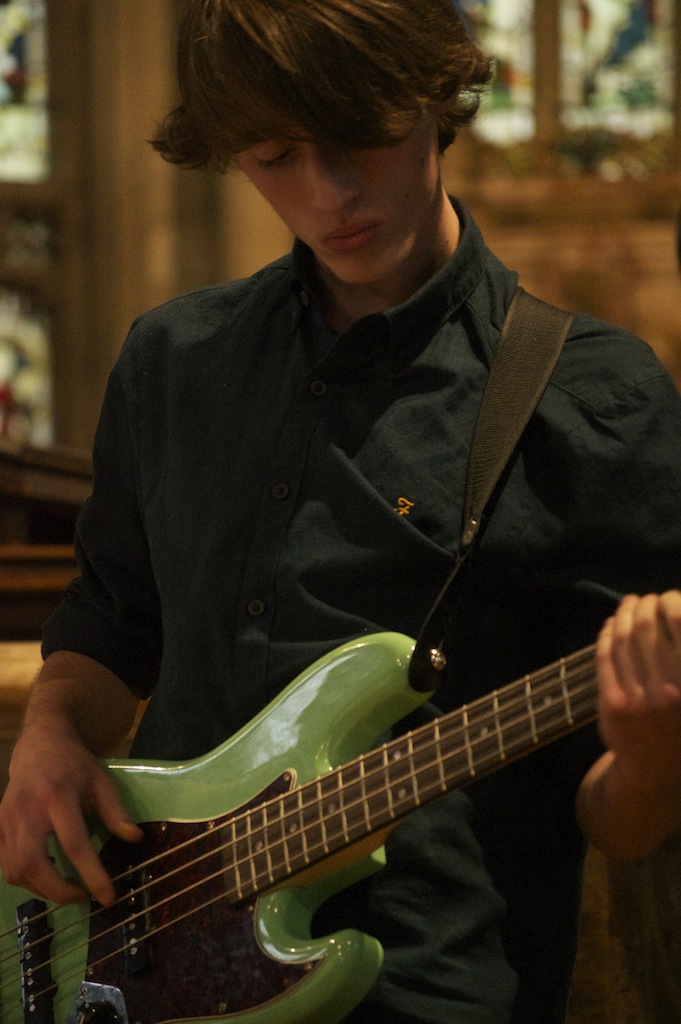
KEY STAGE 3
Year 7
Students develop their fundamental musical skills through:
- Fundamental Skills – reading treble clef notation, rhythm and pitch, keyboard skills and vocal technique
- Ground Bass – developing two-handed keyboard skills and reading treble and bass clef
- Mardi Gras – keyboard chords, vocals and the musical traditions of New Orleans
- Hip Hop – composing and producing a track using Logic Pro
- Samba – rhythmic performance and ensemble skills using percussion
- Guitar and Vocals – guitar chords, strumming patterns and vocal accompaniment
Year 8
Students build on their musical knowledge and develop greater independence through:
- Chopin's Waltz in A Minor – keyboard performance and understanding waltz style
- Waltz Composition – composing using notation software
- The Blues – keyboard performance, blues structure and improvisation
- Afrobeats – composing and producing a track using Logic Pro
- The Beatles – Let It Be – guitar and vocal performance
- Brit Rock and Britpop – developing specialist instrumental skills and performing as a band
Year 9
Students develop more advanced performance, composition and music technology skills through:
- Havana and Afro-Cuban/Salsa Music – keyboard performance and Latin musical styles
- Protest Music – composing to a brief using Logic Pro or live instruments
- Reggae – developing skills on drums, bass, guitar, keyboard or vocals
- Reggae Band – developing ensemble performance skills
- Soundtrack Composition – composing and producing music to a visual brief using Logic Pro
Across Key Stage 3, students develop skills in solo and ensemble performance, composition, music technology, listening and analysis, notation and improvisation. The curriculum introduces students to a wide range of musical traditions, genres and cultures while preparing them for further study at GCSE.
KEY STAGE 4

Key Stage 4 – GCSE Music (Pearson Edexcel)
Instrumental Lessons
All students taking GCSE Music receive a 50% discount for individual instrumental lessons. Well-equipped practice rooms are available at lunchtimes and instrumental teachers run a range of ensembles in which GCSE students are expected to take part. More information about extra-curricular provision can be found here.
Year 10
- Performing: development of solo and ensemble performance skills
- Composing: developing composition and music technology skills
- Areas of Study:
- Instrumental Music 1700–1820 (Brandenburg & Beethoven)
- Vocal Music (Purcell & Queen)
- Music for Stage and Screen (Defying Gravity & Star Wars)
- Fusions (Afro Celt Sound System & Esperanza Spalding)
- Listening and appraising skills including dictation
- Regular performance and composition assessments in class
Year 11
- Continued development of solo and ensemble performance
- Composition to a brief
- Free composition
- Listening and appraising
- Revision and preparation for the final listening examination
Assessment
Performing – 30%
Students perform:
- One solo performance
- One ensemble performance
Performances are recorded and internally assessed before being externally moderated by Pearson.
Composing – 30%
Students complete:
- One composition responding to a brief set by Pearson
- One free composition
Compositions are internally assessed and externally moderated.
Listening and Appraising – 40%
A 1 hour 45-minute written examination assessing students' understanding of musical elements, contexts and language through familiar and unfamiliar music.
The examination covers the four Areas of Study and includes questions relating to the set works studied during the course.
Key Stage 5 Music Technology
William Ellis has offered A Level Music Technology as part of the LaSWAP Sixth Form for almost 20 years. The course gives students practical experience of recording, music production, composition and sound engineering, alongside an understanding of the technology and principles behind modern music production.
Students follow the Pearson Edexcel A Level Music Technology (9MT0) specification, developing creative, technical and analytical skills through a combination of practical production work and theoretical study.
ENTRY REQUIREMENTS
To study A Level Music Technology at LaSWAP, students need:
- Grade 5 or above in Music or Music Technology
- Grade 5 or above in Maths
- The standard LaSWAP entry requirements for the A Level pathway
LaSWAP publishes its entry requirements annually and requires students to meet the relevant requirements for the courses they wish to study.
COURSE SPECIFICATION
The Pearson Edexcel A Level Music Technology course consists of four components:
Component 1 – Recording (20%)
Students develop professional recording techniques through practical studio work. They record and produce a track, developing skills in microphone selection and placement, recording techniques, editing, mixing, effects processing and mastering.
Component 2 – Technology-based Composition (20%)
Students create an original technology-based composition, developing skills in sequencing, synthesis, sampling, audio manipulation, effects processing and arrangement.
Component 3 – Listening and Analysing (25%)
Students analyse unfamiliar commercial recordings and develop their understanding of recording and production techniques, the principles of sound and audio technology, and the development of recording and production technology.
Component 4 – Producing and Analysing (35%)
Students work with audio and MIDI material to demonstrate their understanding of editing, processing and mixing techniques. They apply their knowledge of sound and audio technology to practical production tasks.
The specification is built around three key areas of study: recording and production techniques; principles of sound and audio technology; and the development of recording and production technology.
FACILITIES
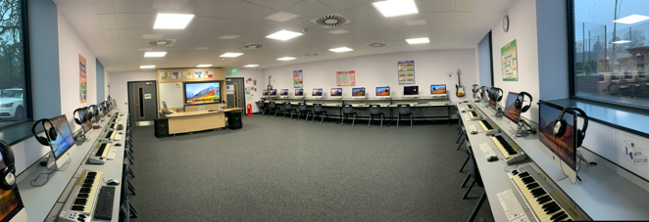
Our Music Technology course is based in purpose-built music facilities, including a dedicated Mac suite and an industry-standard recording studio.
Students have access to professional recording and production equipment and develop their skills through practical, hands-on projects throughout the course.
INDUSTRY LINKS
We place a strong emphasis on connecting students with the wider music industry and giving them opportunities to experience professional music environments.
Students have benefited from links with Pirate Studios and Somerstown Festival, including opportunities to undertake work experience and gain experience of working on real-world music projects.
We have also welcomed Nigel Godrich, one of the UK's leading record producers and engineers, to work with our students.
These opportunities help students understand how the recording, production and technical skills developed on the course are applied in professional settings.
PROGRESSION
Music Technology students at William Ellis have progressed to further study in music production, music technology, sound engineering and related creative subjects.
Previous students have gone on to study at institutions including:
- ICMP – Institute of Contemporary Music Performance
- University of Surrey – Music and Sound Recording (Tonmeister)
- University of Leeds
- University of Manchester
- BIMM University
The course provides a strong foundation for further study and careers in areas including music production, recording engineering, sound engineering, live sound, composition and the wider music industry.